

Differentiating the layers of Pontacol multilayer films
Multilayer films from Pontacol combine the properties of different thermoplastic adhesive films to create an adhesive bond between surfaces that cannot be joined by a thermoplastic single-layer adhesive film. Furthermore, these multilayer films can be used to bond plastic when back-injecting metals or to make surfaces paintable.
Pontacol multilayer films
Thermoplastic multilayer adhesive films with and without barrier layers are the best choice for bonding incompatible materials. The areas of application and substrates for the use of thermoplastic adhesive films are extremely wide-ranging: from textiles to aluminum foil or honeycomb panels, from PVC to PU foam. Thermoplastic adhesive films can not only bond, but also waterproof, reinforce, seal or coat. There are virtually no limits to the possibilities.
Asymmetric multilayer films are based on inherently different polymers and therefore have two different external layers. To ensure the bond between different substrates the multilayer film must be applied precisely over the entire surface and above all correctly aligned.
Before the film is applied, the polar side (copolyamide, copolyester, thermoplastic polyurethane) and non-polar side (polyolefin, polypropylene) of the film must be clearly identified. A test ink for determining the surface tension of 38 mN/m is best suited for this purpose.
| non-polar layer | polar layer |
| Polyolefin | Copolyester |
| Polyolefin | Copolyamide |
| Polypropylene | Copolyamide |
| Polyolefin | thermoplastic Polyurethane |
| Polypropylene | thermoplastic Polyurethane |
Table 1: Pontacol multilayer films for which the top layer can be determined with a test ink.
Identification of the top layers
To clearly identify the polar and non-polar side, apply a line with a test pen or test ink to each side of the multilayer film. On the polar side of the film, the ink mark leaves a continuous, covered line on the surface (left picture). On the non-polar side, the ink marking does not form a continuous line on the film surface, as the test ink forms blobs (right picture).
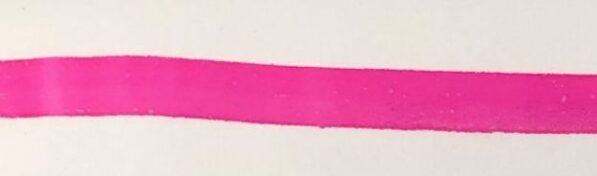
left picture: polar layer
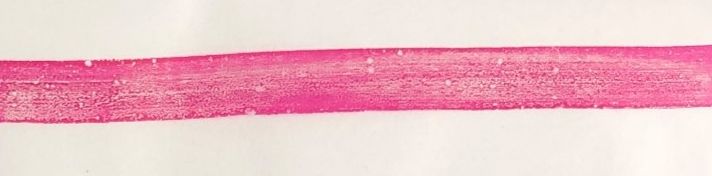
right picture: non-polar layer
Conclusion
The method described is based on a test pen for a surface tension of 38 mN/m. Test inks are available in different forms from various manufacturers for different surface tensions. The test ink polarity should be selected to be neither too high nor too low according to the surface tension, in order to be able to clearly differentiate between the sides. Applying too much test ink also makes it difficult to distinguish the layers.
This method is an easy-to-use alternative to determining the surface tension or polarity by measuring the contact angle in order to test the correct alignment of a Pontacol multilayer film quickly and easily.
In addition to the different surface layers of asymmetrical multilayer films, this method can also be used to distinguish polar single-layer adhesive films from their non-polar polyolefinic carriers.